Tuesday, March 7, 2023

Disks:


Disks:

"Do what thou wilt shall be the whole of the Law."
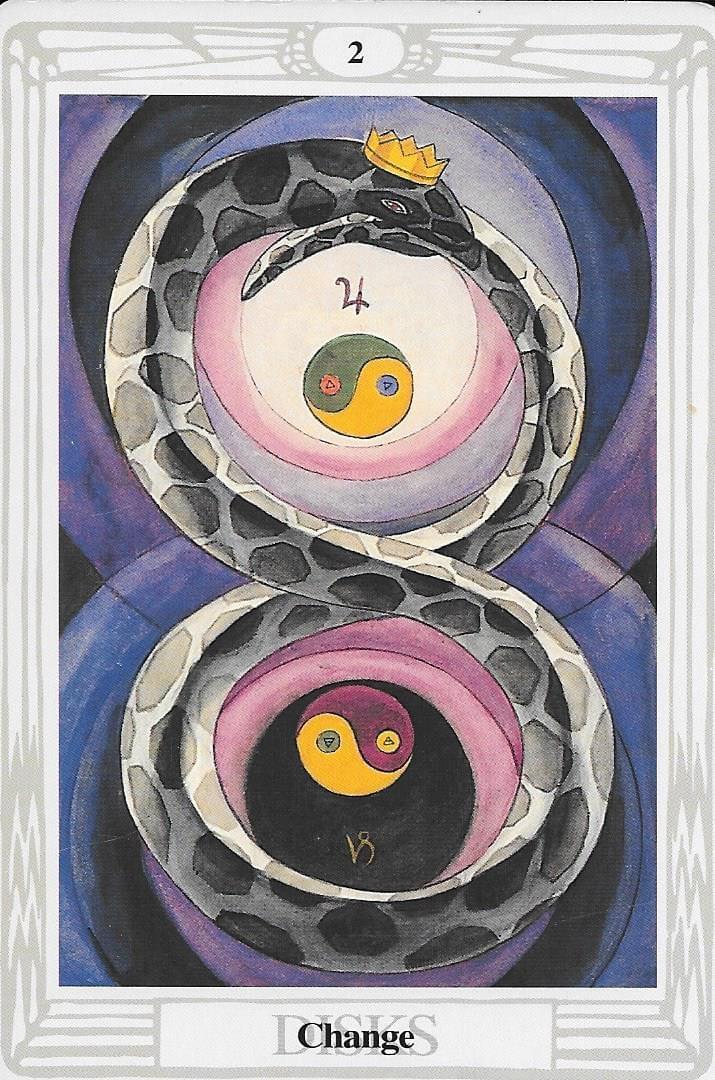


Two of Disks:

This card refers to the Will being stable in a world of constant change, this Will refers to inspiration or the True Will. The idea being, that the Will is the inherent drive towards realizing one’s purpose, the latter is a manifestation of the ego. However, for this Will to be realized, one needs to find stability to support it. Stability is found through union, which is a requisite for realizing the potential inherent in the card. This must be done via harmonizing the magician’s inner and outer worlds, as per the suit's association with Assiah. However, this harmonizing is not indicated as having been achieved thus success is not necessarily implied by the symbolism.

“The number Two, Chokmah, here rules in the suit pertaining to Earth. It shows the type of Energy appropriate to Two, in its most fixed form. According to the doctrine that Change is the support of stability, the card is called Change.”

Crowley, The Book of Thoth


Three of Disks:

The card represents life being in harmony with the subject’s aspiration, all is in balance and symbolized by the three disks surrounding the Pyramid. The magician is experiencing congruence between the Will and Understanding, their influence naturally links to the World of Matter, via the aspiration which is here supported by Chokmah. The aspiration has found, through this harmony, a perfect inbreathing that manifests as materialization of his original inspiration. The first two cards in this suit are indicative of union and the need to maintain balance for the work to persist, thus they are symbolic of both the negative and positive aspects of these ideas. These two cards should be read in context of the individual’s relationship with Assiah, as the health of this relationship is determined by the relationship between the Ruach and the Nephesch, which when incongruent Heaven and Earth may not adequately be united. These parts of the Soul wouldn’t necessarily balance the intensity of the inbreathing, in which case, the influence from Binah and Chokmah may cause trouble.

“The influence of Binah on the sphere of Earth shows the material establishment of the idea of the Universe, the determination of its basic form.”

Crowley, The Book of Thoth


Four of Disks:

The inspiration of the union between Binah and Chokmah, is here seen as the perfect manifestation thereof. Since the suit corresponds to Assiah, this card represents a clear plan for action that may be accurately expressed through the relationship between the magician and his creativity. It is a perfect idea that is in harmony with the magician’s environment, thus what is intimated in the card is guarding the citadel of creativity. Hence, the card indicates control and continued work being done, that should result in a positive end.

“The generating idea is exhibited in its full material sense.”

“The disks are very large and solid; the suggestion of the card is that of a fortress. This represents Law and Order, maintained by constant authority and vigilance.”

Crowley, The Book of Thoth


Five of Disks:

The card suggests the world of Assiah and the Nephesh being in complete disharmony, and suggests the need for the issue to be confronted. It is impossible under these types of circumstances to think in any higher sense, thus, the Ruach is overcome with Worry. The querent is unable to find his footing, due to his inability to adapt to and control the elements of his everyday life. This can only be remedied by confronting the elements of his own being with honesty. This is by no means a fleeting situation and a lot of work will need to be done, before the querent will be able to express himself in any higher sense, than merely survival.

“The symbol represents five disks in the form of the inverted Pentagram, instability in the very foundations of Matter. The effect is that of an earthquake.”

“The effect is of intense strain; yet the symbol implies long-continued inaction.”

Crowley, The Book of Thoth


Six of Disks:

This card means perfection, and this indicates the Ruach as the Ego. It suggests someone who is at perfect ease and in perfect control of him or herself and the world around. This perfection naturally tends towards creativity and is able to find this expression within most circumstances. The card suggests control established via the congruence mentioned above, which obviously implies a great ability to adapt to different situations. It symbolizes creativity descending through the Four Worlds, which has now been manifested in Assiah.

The number Six, Tiphareth, as before, represents the full harmonious establishment of the Energy of the Element.

Crowley, The Book Thoth


Seven of Disks:

The card suggests all the aspects of Yetzirah and Assiah having been corrupted. There is no way for positive expression and usually indicates material concerns resulting in an inability to realize goals. Frustration is significant to this card and has a tendency to lead to behavior unconducive to a beneficent outcome. The subject is thus at odds with the world, and this situation keeps getting worse on account of not being able to overcome the strain of his circumstances, that lead to more intense conflict with the outside world, to incumber progress.

The number Seven, Netzach, has its customary enfeebling effect, and this is made worse by the influence of Saturn in Taurus.”

“They suggest bad money.”

Crowley, The Book of Thoth


Eight of Disks:

The last three cards are ruled by Virgo. This card especially presents the idea of work towards the completion of an idea or task. It is loving commitment to that which demands one to stay committed to for its final execution. This commitment is done joyously, and it symbolizes putting thought into action, that is supported by the influence of Mercury as per the card's association with Hod. For example: A question pertaining to finances, would have this card as planning for the final result of perhaps an investment or reallocation of funds. This is done under the auspices of Mercurial influence, which is a symbol of intelligence and problem solving. Therefore, this card may symbolize the need for Prudence as indicated in the card’s title.

“It signifies intelligence lovingly applied to material matters, especially those of the agriculturalist, the artificer, and the engineer. One might suggest that this card marks the turn of the tide.”

Crowley, The Book of Thoth


Nine of Disks:

This card has a similar meaning to the Six of Disks but on a lower level of experience. It means that undertakings have been thought out and are accompanied by good fortune. As with the Six, this card shows a person well received by others, which makes life a lot easier. This is however not as a result of the same type of influence as in the Six of Disks, but rather stems from confidence arising from the certainty of well-planned actions. There is thus no contradiction between action and motivation for the subject represented by this card, there are no obstacles to that which the querent has already set out to accomplish.

“The number Nine, Yesod, inevitably brings back the balance of Force in fulfillment. The card is ruled by Venus in Virgo. It shows good luck attending material affairs, favour and popularity.”

Crowley, The Book of Thoth


Ten of Disks:

This card represents the end. Everything in the card presents one with the idea of completion, which means there is potential for sluggishness. Whatever has been accumulated should serve this process and aid the impulse to create, Wealth is not an end in itself, but should be seen as a means to facilitate the development of the individual. So, as with all the other cards relating to this Sephiroth, the work is done and now it is time to start anew or move on. Wealth may be referring to influence gained, as a result of successful completion of work, thus the below quote could be interpreted as referring to anything that has produced such influence.   

“The force is completely expended and results in death. Mercury rules this card in Virgo; and this may imply that the acquired wealth, being inert, will be dissipated unless put to further use by devoting its power to objects rather than mere accumulation.”

Crowley, The Book of Thoth 

"Love is the law, love under will."


Wednesday, March 1, 2023

Swords:


Swords:

“Do what thou wilt shall be the whole of the Law.”


Two of Swords:

This card represents the Logos and the Intellect working in perfect harmony to transmit the Supernal influence and which creates the Magickal Childe. This creative manifestation results from the Ruach’s role as that which connects the Nephesh to the Supernal influence. So that finally, what was perceived as inspiration, now finds a definite function via the Ruach’s connection to Assiah and the inspiration manifested from the union between the intellect and Atziluth.

“It is subject to change as is no other suit. It represents a general shaking-up, resulting from the conflict of Fire and Water in their marriage; and proceeds, when Earth appears, to crystallizations.”


Three of Swords:

This card symbolizes the Ruach’s inability to properly express itself, the Swords are weighed down by the force of Binah and depression and distempers arise as a result. This card is another representation of the Dark Night of the Soul, although there is creativity, it is unable to be expressed, as the unconscious impulses and emotions are too overpowering. As a result, inspiration in Atziluth is corrupted, or at worse, the subject is paralyzed to express any of the higher characteristics associated with the suit of Swords.

“There is an intense lurking passion to create but their children are monsters. This may mean the supreme transcendence of the natural order. Secrecy is here, and perversion.”

Crowley, The Book of Thoth


Four of Swords:

The card represents the Ego having given up its aspiration to the limiting forces of the world around it. This limitation could be experienced as either comfortable or uncomfortable, perhaps the Will of a coward has been broken and he has forsaken himself for his need of security. The card presents us with the idea of authority having defeated the Will and there is no change in sight, routine and structure are characteristics of the card’s meaning. Therefore, for those who are willing to conform and subject themselves, for those unwilling or unable to fight for their sovereignty, this card is perfectly auspicious. However, the only way forward is through violence and war, thus the notion of “Truce”, is a most foreign idea to Thelema, or anyone aspiring towards progress.

“As always, the Four is the term; as in this case there is no true justification for repose, its disturbance by the Five holds no promise of advance; its static shams go pell-mell into the melting pot; the issue is mere mess, usually signalized by feotid stench, But it has to be done!”


Five of Swords:

This card symbolizes the martial tendency having been defeated, in the previous card complacency was the dominant factor. In this card the ability to adjust to circumstances that may lead the way toward progress has been overwhelmed. There is no desire for change, even when faced with its necessity, the subject lacks the ability to do so. The person represented in this card is incapable of learning from and incorporating his experiences into a new understanding of the world around him. He is an imbecile in an ever-growing world populated by intellects, who have the ability to adapt and overcome. Hence, he sits and waits for his chance to be included, however he lacks the competence for this realization to ever be brought to fruition.

“Geburah, as always, produces disruption; but as Venus here rules Aquarius, weakness rather than excess of strength seems the cause of the disaster. The intellect has been enfeebled by sentiment. The defeat is due to pacifism. Treachery may also be implied.”

Crowley, The Book of Thoth


Six of Swords:

The card is representative of one who has established perfect union and is free to do his Will unhampered by influence. It is Tiphareth in the suit of Swords, both of which are attributed to the same element, there is no conflict either from above or below. He is master of his own creation in every respect, all influences only serve to foster his momentum. Therefore, the card is symbolic of a state in which progress is nurtured and sustained by the Intellect. Although, successes as well as failures are inherent in the card as indicated by its name, “Science”, the subject maintains a steady climb towards higher ground, which is ever joyous, as indicated by the card’s position on the Tree of Life. As Tiphareth forms the link between Heaven and Earth, the card is symbolic of perfect equilibrium having been established between the two, wherefrom, the subject’s Will and the Universal Logos are working in perfect harmony. In other words: the Supernal influence and the Material influence upon the Ruach have been brought under control to become perfect reflections of each-other and expressed as Beauty. Although, this state of perfection is only maintained as long as the magician is able to keep adapting to external circumstances, but in light of the card it represents the subject in his or her element and a vantage point indicating success.

“The perfect balance of all mental and moral faculties, hardly won, and almost impossible to hold in an ever-changing world, declares the idea of Science in its fullest interpretation.”

Crowley, The Book of Thoth


Seven of Swords:

The Seven of Swords indicates the need for receptivity and awareness, any unwarranted self-expression within these types of circumstances may lead to failure. Hence it suggests that there is a need for passivity and agreeableness, this is not a lasting situation per say, however at the present time the subject is confined by his immediate environment. It presents one with the notion of fleeting circumstances wherein a certain level of compromise is demanded for the situation to result in an amiable end. This card is calling on the Ruach to maintain control of the emotions, especially with regards to confounded speech and action. Obviously, one’s inner and outer worlds being what they are, maintaining control may prove to be quite the task, as hinted at by the card. There is a way out of the situation, as the subject is at ease, which creates a willingness to subjugation on part of the subject. Although the situation is not permanent, sooner or later he will need to make a change. Whether the change is forced or willed is up to the subject of the reading.

“There is vacillation, a wish to compromise, a certain toleration. But, in certain circumstances, the results may be more disastrous than ever. This naturally depends upon the success of the policy. This is always in doubt as long as there exist violent, uncompromising forces which take it as a natural prey.”


Eight of Swords:

This card reflects the strong Mercurial influence of Hod, suggesting that circumstances are imposing and difficult to adjust to. These interferences are objective and demands adjustment for the subject to successfully pass through them. The inability to navigate the situation stems from thoughts and inclinations stirring under the surface. These unconscious feelings give way to indecision which results from the Ruach losing control over the Will and emotions, hence the aspiration is unrealized. One is seemingly jumping from one aim to another without finding a proper foundation for the Will and the aspiration to take hold.

“The number eight Hod, here signifies lack of persistence in matters of the intellect and of contest. Good fortune, however, attends even these weakened efforts, thanks to the influence of Jupiter in Gemini, ruling the Decan.”

Crowley, The Book of Thoth


Nine of Swords:

The card’s name is Cruelty and symbolizes the Shadow, which is here at its most imposing. The Shadow, as Jung called it, represents all our behaviors that are repressed so that the Nephesh may function properly. These impulses sometimes rise to the surface, perhaps an ill-fated relationship or ill-fated job prospects are examples of the types of things which could be the cause of such a stirring. The card suggests that these, what some might refer to as evil impulses, are overpowering the intellect. Thus, according to the subject’s inability to reign in the Shadow, the best advice is to change the stimulus, otherwise the situation will end in disaster.  

“The Swords no longer represent pure intellect so much as the automatic stirring of heartless passions. Consciousness has fallen into a realm of unenlightened reason. This is the world of the unconscious primitive instincts, of the psychopath, of the fanatic.”

Crowley, The Book of Thoth


Ten of Swords:

This card is the exact opposite of the Six of Swords, which was in perfect harmony with Heaven and Earth to materialize the Will in Assiah. But here we have an intellect that is incapable of establishing a clear congruences with the circumstances around it. As a result, self-imposed limitations resulting from a lack of understanding leads to an inability for the intellect to express itself productively in the world.  

“It shows the reason run mad, ramshackle riot of soulless mechanism; it represents the logic of lunatics and (for the most part) of philosophers. It is reason divorced from reality.”

Crowley, The Book of Thoth

“Love is the law, love under will.”


Monday, February 20, 2023

Cups:


Cups:

“Do what thou wilt shall be the whole of the Law.”


Two of Cups:

The Will of Chokmah is united with the Understanding of Binah, the card is in respect to its meaning contiguous to the Two of Wands, which was symbolized as ecstasy. The card represents the initial inspiration of Chokmah being integrated, so that it will find a workable avenue of expression. Still united with the Will, Binah and Chokmah are lost in the ecstasy thereof, thus the card symbolizes being swept away in the beauty of the moment, when the Two and Three are lost in ecstasy and mutually destroyed by the experience. The only concern is experience for its own sake, as Binah is the womb and the vehicle of inspiration, the magician is lost in the meditation thereof, hence Agape is the nature of the above-mentioned union.

“The number Two referring to Will, this card might really be renamed the Lord of Love under Will, for that is its full and true meaning. It shows the harmony of male and female: interpreted in the largest sense. It is perfect and placid harmony, relating an intensity of joy and ecstasy.”

Crowley, The Book of Thoth.


Three of Cups:

The card is Binah of Briah, it indicates the nurturing quality of the Great Mother, and the necessity thereof, it may be seen as Understanding of Understanding, as linking the f Archetypal forms of Atziluth to the Creative world. Mercury’s influence as the Universal Logos becomes the greatest influence upon the Cups and needs to be dealt with in kind. Thus, it is symbolizing a period of gestation, following the union depicted in the previous card and demands nurture, and a type of passive vigilance, as the symbolism suggests a state of receptivity and development. Mercury is the Trickster and Teacher, he is also that force in nature which fosters creative development, and this signifies his influence on the card.

“The Card is referred to the influence of Mercury in Cancer; this carries further the above thesis. Mercury is the Will or Word of the All-Father; here its influence descends upon the most receptive of the Signs.”

Crowley, The Book of Thoth.


Four of Cups:

The Water has turned into dew, there is no real support, as the card suggests the lack of a firm foundation to manifest the purity of the element. All is well for the time being, but the consequences of Binah’s inability to find expression, is starting to raise its head in the form of restlessness. The card threatens the risk of becoming too familiar with one’s current circumstances and indicates the necessity for understanding and change. However, the elements are congruent, and this change will more than likely be forced upon the querent, therefore the unconscious desires need to be understood in order to lead the way towards further development.

“The card refers to the Moon in Cancer, which is her own house; but Cancer itself is so placed that it implies a certain weakness, an abandonment to desire. This tends to introduce the seeds of decay int the fruit of pleasure.”

“Four is the number of the Curse of Limitation, of Restriction. It is the blind and barren Cross of equal arms, Tetragrammaton in his fatal aspect of finality, as the Qabalist knew him before the discovery of the Revolving Formula whereby the Daughter, seated upon the Throne of the Mother, “awakens the Eld of the All-Father”.”

Crowley, The Book of Thoth.


Five of Cup:

Stagnation and misunderstanding have resulted in emotional turmoil; life and the world are turning into an unbearable state, reflecting disdain and melancholia. This is resulting from not having found a means for the element to properly express itself, the Luxury of the previous card has been devastated by incongruent parts of being. This entails a shift in perspective was necessary, the element of Fire is entirely incompatible with this card, and is felt as an assault, that is incapable of being overcome. Hence this card is indicative of having exhausted the faculties represented by Water, as understanding has failed to fulfil its role in service to the individual. Hence there is nothing to cradle the Soul and the individual is drifting towards an unwelcome end, this card follows the complacency of the previous card, as that which could have been avoided.

“The attribution is also to Mars in Scorpio, which is his own house; and Mars is manifested on the lowest plane of Geburah, while Scorpio, in its worst aspect, suggests the putrefying power of Water. Yet the powerful male influences do not show actual decay, only the beginning of destruction; hence the anticipated pleasure is frustrated.”

Crowley, The Book of Thoth.


Six of Cups:

This card represents perfect harmony between the emotions, intellect and understanding. It is a space where things are easy, life becomes a joyous expression of the divine Will. All is in perfect balance; within the context of work: whatever is required is effortlessly obtained. Every step forms part of a beautiful dance to a rapturous love song, creativity seemingly emanating from divine grace. The intellectual energy of Tiphareth has united with the Mother to become the embodied Logos without restriction to do the Will of God upon the Earth. Although the card is Air of Water, it may be more applicably considered as the union between Binah and Tiphareth, from whence the workings of creativity are free to find its expression, as manifesting the Logos.

“Pleasure, in the title of this card, must be understood in its highest sense: it implies well-being, harmony of natural forces without effort or stain, ease, satisfaction. Foreign to the idea of the card is the gratification of natural or artificial desires. Yet it does represent emphatically the fulfilment of the sexual Will, as shown by the ruling Sephira, planet and sign.”

Crowley, The Book of Thoth.


Seven of Cups:

The Seven of Cups is attributed to Netzach and is Fire of Water, it indicates not having properly understood the Will’s nature and function. This misunderstanding gives rise to compulsive behavior stemming from the unconscious, these behaviors are the result of repressed impulses and feelings. These feelings, if they had been expressed naturally, would have aided in the development of the self. However, resulting from an individual’s incoherence with his true nature, they have manifested as Debauch. Karma is nothing but self-punishment, and the consequence of not having fulfilled one’s purpose. The subsequent result spells gloom for the querent and the card warrants a long hard look at what the cause of his ill dealings with his world might be. Or, as in the case of Chesed and Geburah, he may find himself torn from his current position into a less than comfortable one. Since the actions taken within the context of the question and represented by this card are going against the nature of the querent, they tend to create tremendous emotional turmoil. The turmoil suffered, however, is also the shadow cast by the guiding light for reestablishing equilibrium, within the self and with the world around.

“The card is almost the “evil and averse” image of the Six; it is a wholesome reminder of the fatal ease with which a Sacrament may be profaned and prostituted. Lose direct touch with Kether, the Highest; diverge ever so little from the delicate balance of the Middle Pillar; at once the holiest mysteries of Nature become obscene and shameful secrets of a guilty conscience.”

Crowley, The Book of Thoth.


Eight of Cups:

This card is Hod of Binah and accordingly symbolizes Mercury's influence on Briah, off the Middle Pillar, the element is in disharmony, and the card indicates misfortune resulting from misunderstanding. The Eight of Cups represents the Dark Night of the Soul, brought upon by the inquirer’s inability to act and now having traveled too far, he is lost and alone. This card could easily be manifested by the improper actions related in the last card, there is no greater sin than the denial of self. This card reflects purgatory having been acquiesced by way of such self-denial. Melancholia may be the result of an imperfect understanding of the Will, leading to a lack of creativity, or it could be from the complete renouncement thereof, as may be symptomatic of Christianity. The querent has found himself unable to adequately express his nature and now finds himself within this morass called Indolence. In fact, in many instances, it may have been for his lack of trying and indeed Indolence, by manner of which his gloomy disposition was arranged.

“Compare with the last card; it represents the opposite and complimentary error. The one is the Garden of Kundry, and the other the Palace of Klingsor. In the psychopathology of The Path, this card is the German Measles of Christian Mysticism.”

Crowley, The Book of Thoth.


Nine of Cups:

Air of Water, the card again suggests the blissful congruence of self in harmony. As the Nine is Yesod, it presents the reader with the idea of understanding having come to a fruitful end. Yesod’s position on the Tree of Life, indicates a womb and is called the Gate, this symbolism is suggestive of the last part of creation, before the element’s final manifestation into matter. From here there is nothing to hold back expression, as it is moved by inertia of certainty, thus the card’s name is Happiness. Whatever it is, whether it be an inquiry into environmental circumstances, or be it inquiring about matters of the heart, there is only one answer, and that is to let go and move forward. Either way, whether or not the outcome is fruitful or good, is irrelevant, as everything concerning it is already in motion. Everything that was cultivated by work and suffered for, owing to the distress in Netzach and Hod, has now started yielding fruit, hence, the card indicates the hard-earned reward of struggle. The querent has confronted the questions posed in the previous two cards and has passed from them the victor, he is whole and in perfect harmony with himself and the world around him. 

“In this card is the pageant of the culmination and perfection of the original force of Water.”

“It is the most complete and beneficent aspect of the force of Water.”

Crowley, The Book of Thoth.


Ten of Cups:

As Water is Emotion, her manifestation into Matter with its limitations upon perfection, is of a most disturbing quality. What has been sought, is now at odds with the world around it, the world is making in-roads into one’s idea of what the end result of the work must be. Utter frustration, constrained expression and emotional responses in disharmony are significant to the reading of this card. It is always a good idea, to leave well enough alone. This is hard to do, as there is pride and sentimentality indicated in the card, which must be overcome. Unless, it is overcome, the querent runs the risk of being stuck in this position indefinitely, and so the best means out of the situation, is to find something else to occupy the mind, by which the whole play may be enacted all over again.

“The work proper to Water is complete and disturbance is due.”

Crowley, The Book of Thoth.

“Love is the law, love under will.”

Saturday, February 18, 2023

Wands:


Wands:

“Do what thou wilt shall be the whole of the Law.”


Two of Wands:

This card indicates Fire of Fire and ecstasy, hence pertaining to Atzituth it represents pure inspiration and is called Dominion, the Will, symbolized in this card is in every way ecstatic, and it demands that the magician be lost in the rapture thereof. After the burning up of all he was, he is made anew, to manifest this divine inspiration. Thus, the card is symbolic of the ecstatic experience of true inspiration, which via its nature and character is transcendent in every way. Below is a quote concerning the Wand from Magick in Theory and Practice to illustrate this point.

“Hence to will anything but the supreme thing, is to wander still further from it –any will but that to give up self to the Beloved is Black Magick – yet the surrender is so simple an act that to our complex minds it is the most difficult of all acts; and hence training is necessary.”  

Crowley writes about the nature of this surrender in his explanation of the card in The Book of Thoth.

“For destruction may be regarded as the first step in the creative process. The virgin ovum must be broken in order to fertilize it. Fear and repulsion are therefore the primary reaction to the assault. Then, with understanding of the complete plan willing surrender rejoices to co-operate.”


Three of Wands:

This card symbolizes the first step after what was ecstatic experience and inspiration, to be crystalized and expressed as creativity. This card is attributed to Briah, which is Water of Wands and called Virtue. Inspiration perceived as no more than ecstatic rapture is here becoming visible to understanding as it is united with Binah.  Thus, accordingly one may think about the card as, pure creativity having found a vehicle for its expression in Binah, the nurturing mother. Without the influence of Binah, the inspiration will lack a foothold for proper expression, this foothold is found as relating to the nature of the Mother, being the source of creativity as it is brought down into the world of Briah. This vehicle may also be interpreted as any vehicle which may ground the Will and aid its final materialization in Assiah, thus the Two and the Three of Wands present us with the first steps in the creative process.

Crowley writes in the Book of Thoth:

“This card refers to Binah in the suit of Fire, and so represents the establishment of primevil Energy. The Will has been transmitted to the Mother, who conceives, prepares and gives birth to its manifestation.”


Four of Wands:

This card is attributed to Chesed, which is Air - Swords and Fire - Wands  - Atziluth. It is the birth of the child, it is revolving consciousness, or the perfection of life. The child is born into the world of Aether, where it experiences and perfects itself in accordance with its nature. The idea is made perfect, and the creative expression of the Supernals is working in harmony with the Ruach, to foster its expression into the lower worlds, and towards its final materialization.

Crowley writes in The Book of Thoth:

“The original Will of the Two has been transmitted through the Three, and is now built up into a solid system: - Order, Law, Government.”


Five of Wands:

This card is called Strife, which indicates that for the first time the Wands are feeling the limiting influence from Yetzirah on the pure inspiration of Atziluth, which was cradled in Chesed . It is the struggle to maintain perfection, although it is impossible for perfection to be rendered into such a changing environment, limited by the world of formation, thus there is conflict and struggle in order to maintain the initial integrity of the idea. The aim is perfection, logically an impossible task and if this was the only consideration, the notion is burnt up and lost. Re-establishing force is crucial for a successful outcome, although, the auspicious influence of the Mother is present, and from one’s dealings with Binah, the Fire is cooled, and the ship may be steered towards progress. However, without her influence, there is no avenue for this expression to be made manifest and will be corrupted and lose its essential characteristics of perfection.

“The symbol represents the Wand of the Chief Adept, showing that the authority is derived from the superiors, were it not so, this card would be thoroughly disastrous.”

“In this card there is the mitigating influence of the Mother. One of the most difficult doctrines with regard to Geburah is that, while it represents all the tameless irrational energy and disturbance, yet it derives from the benign and gentle influence of the feminine.”

Crowley, The Book of Thoth:


Six of Wands:

The Logos of Chokmah has been completely integrated into Briah, through this union the Will is ready for its manifestation into the lower worlds. The idea is perfectly perceived via Tiphareth, forming the link between the Four Worlds, all complications have been overcome and the subject may from here proceed to express the perfection of his creativity.

“This shows Energy in completely balanced manifestation. The Five have broken up the closed forces of the Four with revolutionary ardour, but a marriage has taken place between them; and the result is the Son, and the Sun.”


Seven Of Wands:

The initial perfection attained in Yetzirah is now experiencing the corruption of contending forces, it comes as a shock and the card is called Valour. The card suggests a state similar to that of Geburah, although there is no way to prevent the loss of initial perfection and balance, that was marked by Tiphareth. The card accordingly presents to the mind the notion of defense, whereas Geburah's position on the Tree, as attributed to Wands, is likened to conquest. The card is associated to Netzach and thus it is Fire of Fire, however within this there is the limiting force of Assiah, which causes conflict upon the Will of the subject. The card symbolizes a loss of balance and the battle of maintaining a firm grip on the Will’s prior perfection found in Briah.

“But the Seven is a weak, earthly, feminine number as regards the Tree of Life, and represents a departure from the balance so low down on the Tree that this implies a loss of confidence.”

“The army has been thrown into disorder; if victory is to be won, it will be by dint of individual valour-a “soldiers’  battle”.

Crowley, The Book of Thoth:


Eight of Wands:

The Eight of Wands symbolizes the final realization of the creative impulse, it is the Will that was broken up in Netzach, being re-equilibrated by the influence of Hod. It indicates the crystallization of the initial Will of Chokmah, that is here manifesting as form. The limiting influence on Netzach is now working in accordance with the creative faculty towards its final manifestation. Although Hod is attributed to Water, the sphere is also attributed to Mercury and so is the card. The strong Mercurial energy indicates the nature of its connection to Yetzirah, as the Logos is reestablished in the lower part of the Tree, before materialization. Thus, the last three cards are represented by Sagittarius, and suggestive of union and birth. However, coordinated effort is necessary, for successful manifestation to occur and is symbolized by Mercury’s influence upon the Wands. Hence the name of the card is Swiftness, as to suggest the nature of the struggle in order to reflect the purity of Tiphareth.

“The pictorial representation of the card shows the Light-wands turned into electrical rays, sustaining or even constituting Matter, by their vibrating energy. Above this restored universe shines the rainbow; the division of pure light, which deals with maxima, into the seven colours of the spectrum, which exhibit interplay and correlation.”

Crowley, The Book of Thoth:


Nine of Wands:

Yesod of Wands, Yesod’s element is Air and the perfect compliment to Fire, it is the same type of stability found in the Four of Wands, but at a lower level, hence, the character of the card is balance. The Will’s materialization does not require effort, it is what it is, thus the card symbolizes the balance which was struggled for in Nezach and Hod. It is the final reflection of the perfection of Tiphareth. In divination, one might say that this is the best possible outcome which could be hoped for.

"The Nine represents always the fullest development of the Force in its relation to the Forces above it. The Nine may be considered as the best that can be obtained from the type involved, regarded from a practical and material standpoint."

Crowley, The Book of Thoth:


Ten of Wands:

The card is called Oppression and is attributed to Malkuth. The Will is smothered by the constraints put on it by the material world, it struggles helplessly to regain its initial perfection. The subject is frustrated by the confining circumstances of life, and cannot find a means of self-expression. It is useless to struggle against the limiting factors presented in this card, as they symbolize the final result. The Will is manifested on Earth, and the only pursuit that may “bring fresh fever from the skies”, is to start anew, or change direction. To get lost in the play of creation again, and become the architect of yet another creation, equally beautiful and satisfying as this.

“The whole picture suggests Oppression and repression. It is a stupid and obstinate cruelty from which there is no escape. It is a will that has not understood anything beyond its dull purpose, its “lust of result”, and will devour itself in the conflagrations it has evoked.”

Crowley, The Book of Thoth:

“Love is the law, love under will.”

Thursday, February 16, 2023

Divining with the Lesser Arcanum:


Divining with the Lesser Arcanum:

“Do what thou wilt shall be the whole of the Law.”

The Suits are dedicated to the magickal weapons, which correspond to the elements, and the Dignitaries specifically represent the different parts of the soul. These parts of the soul are linked to the dominant characteristics of people. For example: some people are more passionate than others and their personalities correspond to Wands, while emotional people are associated with Water and Cups. Paternal people would also be associated with Wands, as relating to its correspondence with Chokmah, and again, maternity would relate to Binah. Intellect is related to Air, Tiphareth and materiality relates to Earth, Malkuth. The above is only a basic look at these elements and the correspondences of these different elements should be considered in as much detail as possible. For example: art and creativity are very much associated to Air, but this would be the Fiery part or the Watery part, that may represent such individuals, these in turn may reflect either the passionate artist as Chokmah influencing Tiphareth, or Binah’s influence on Air, may suggest, the fragile temperament of a drowning artist. These facts must be considered as relating to each individual spread, this means that the cards are read in the same way, that one may look at a landscape, not as judging each individual brush stroke, but for the feeling that the image invokes. In order for this reflection to be correctly intuited by the Soul, he must familiarize himself with as many of the corresponding symbols relating to each element as possible. Hereby, he becomes more acquainted with the nature and the workings of the Astral Light, he is in a sense learning the language of the gods, who he will be conversing with via the art of divination. The work of divination is occupied by the Ruach, and it is important for a magician to constitute this part of his Soul in such a way as to intelligently receive and interpret the symbols. This work is done on the Astral Plane, where the magician develops his intuition by meditating on the cards, thus acquainting himself with the nature of them in the spirit vision. He is essentially imprinting his interpretation of the cards upon his Soul, and establishing congruence with his intuition, which is of course, an unconscious faculty. Where there is union of opposites, there is ecstasy that leads to conception, in this way, the art of divination is no different. There is an inquirer and a seer, a feminine and a masculine element, and these two elements need to be joined in ecstasy, for success to be obtained. From this union, the creative impulse is affected, which manifests inspiration for an accurate interpretation of the cards, which via the above necessitates a correct understanding of the nature of the question posed. It is dependent on a type of empathy supported by the Ruach, so that each card is interpreted uniquely, as relating to each individual reading. Unless such a magickal rapport is established between the querant and the seer, the reading will result in little more than grasping at straws.

The positions of the elemental cards should be carefully considered when tracing their correspondences. The Wands are Yod of the Ineffable Name, the Cups correspond to Heh, the Swords to Vau and the Disks to Heh final. The Knights are Wands and Fire, Queens are Cups and Water, the Princes are Swords and Air, and the Princesses are Disks and Earth. These elements are placed on the Tree of Life in the following manner, Yod=Chokmah, Heh=Binah, Vau=Tiphareth and Heh final=Malkuth. However, when looking at the Dignitaries, they represent the characteristics of people, so it is helpful to also attribute them to the sephiroth of the Astral Triad. Therefore, Knights=Netzach/Chokmah, Queens=Hod/Binah, Princes=Yesod/Tiphareth and Princesses are Malkuth/Malkuth. Each element is also endowed with its unique spirit, and this spirit reflects the most obvious part of the nature of the element. The nature of the element is described as either passive or active, Water and Earth are passive, and Air and Fire are active elements, the conclusion we may draw from this is, that, passives are compatible with other passives and actives with actives. Water is compatible with Earth, and when analyzing the symbolism, we may look to the fact that Water is the necessary ingredient for sustaining life on Earth, thus they are in perfect harmony. Regarding two dominant characteristics of individuals reflected in Discs and Cups, I might draw the conclusion, that the person indicated, is maternal and materialistic, in which case, she would make for the perfect caregiver. These characteristics are, of course, not related to the sephiroth of the Astral Triad, but to the whole Tree of Life, as Binah and Malkuth. This kind of analysis, being perfectly valid, does leave one with a lot of missing information and is meant, as a type of foundation, from where a more detailed inquiry follows utilizing the pentagram. The magician is not via the art of divination working in broad strokes, such as with the above example, but is homing in on the individual’s intent, who is posing the question, thus the attributes related to the pentagram, become invaluable accompaniments to the practice.

Some of the characteristics of the dignitaries may be found by employing some common sense and of course, Aleister Crowley’s 777. Below follows some attributes that may be applied to the Dignitaries.

Knight of Wands=Devotion, Unselfishness, Joy, Passionate, Willful, Proud, Inspiring, Charitable, Spiritual.

Queen of Cups=Honorable, Truthfulness, Compassion, Maternal, Emotional, Empathetic, Compassionate.

Prince of Swords=Devotion to the Great Work (Self), Independence, Friendliness, Intelligent, Creative, Inspired.

Princess of Disks=Skepticism, Sensual, Practical, Hard Working, Family Orientated, Focused, Stable, Material.

Now in order to figure out some of the obvious characteristics of the other Dignitaries, all we have to do, is mix them up as follows:

Knight of Cups: Emotional, Compassionate, Passionate, Truthful, Proud, Petti, Has a tendency to Brood, Temperamental etc.

Thus, by figuring out these basic characteristics, we may get an intuitive sense of all these cards, which will be of much greater benefit, than simply memorizing the meaning of the cards. Once the attributes have been listed, one may start scrying on each individual cards, by doing so, he will internalize the meaning of the cards.

The suit cards are attributed to the ten sephiroth on the Tree of Life and the nature of the suit and the sephirah are taken into account when the meaning of a card is determined. Thus, the Three of Disks (Water/Earth) presents us with a very fruitful idea, and can only symbolize growth and creativity, the card is called Work. However, when looking at the Two of Disks (Fire/Earth), it indicates that we are dealing with a rather devasting influence on the element, and the card is called Change. Below is what Crowley writes about these cards in his Book of Thoth:

CHANGE

TWO OF DISKS

“The number Two, Chokmah, here rules in the suit pertaining to Earth. It shows the type of Energy appropriate to Two, in its most fixed form. According to the doctrine that Change is the support of stability, the card is called Change. Its celestial rulers are Jupiter and Capricornus; and these symbols are most inharmonious, so that in practical matters the good fortune of Jupiter is very limited. Their influence on the card is not great. Yet, Jupiter being himself the Wheel (Atu X), he emphasizes that idea.”

WORK

THREE OF DISKS

“The influence of Binah in the sphere of Earth shows the material establishment of the idea of the Universe, the determination of its basic form. It is ruled by Mars in Capricornus; he is exalted in that Sign, and therefore at his best. His energy is constructive like that of the builder or engineer.”

The suit represents the element that is being affected by the sephirah, hence Binah on Earth, is symbolic of the effect, that Water has on the Earth’s soil. However, if we change it around and make it Ten of Cups, we get a whole different picture. This card symbolizes that too much of a good thing is no longer good. Think of muddy water: imagine boredom, or a need for expression, that is now finding a negative outlet via the emotions. This state of uncertainty has led to the inability to choose, a great shock, perhaps enforced by change could move things forward. But it is certainly not a positive card to draw. The Four of Wands, however, is a card that symbolizes creativity, there is nothing to stop this inspiration, as these elements are in perfect harmony and the Will is now free and supported by momentum. This card is called completion and here is what Crowley writes about it in the Book of Thoth:

COMPLETION

FOUR OF WANDS

“The card refers to Chesed in the suit of Fire. Being below the Abyss, it is the Lord of all manifested active Power. The original Will of the Two has been transmitted through the Three and is now built up into a solid system: Order, Law, Government. It is also referred to Venus in Aries, which indicates that one cannot establish one’s work without tact and gentleness.”

“Love is the law, love under will.”

  The Aeon: Do what thou wilt shall be the whole of the Law. 20. Then also the Pyramid was builded so that the Initiation might be complete....